How Does Tesla’s Flying Roadster Work? The Technology, Thrusters and Aerodynamics Explained
Explore the science behind Tesla's next-gen Roadster demonstration: SpaceX cold-gas thrusters, fan suction technology, vehicle aerodynamics, and computer-controlled aerial physics.
Tesla has captured global attention with an astonishing live demonstration of its redesigned second-generation Tesla Roadster at SpaceX's rocket development and testing facility in McGregor, Texas. Developed in close engineering collaboration with SpaceX, the electric sports car showcased maneuvers unprecedented in the automotive industry: ascending a steep vertical curved track, adhering completely upside down, detaching into mid-air with rocket thrusters, executing controlled aerial rotations, and cushioning its touchdown on all four wheels.
With Tesla and Elon Musk targeting production for 2028, automotive enthusiasts and engineers alike are asking: how does this technology actually work? Is this genuinely a "flying car," or is it an extraordinary fusion of aerospace reaction control, extreme fluid dynamics, and electric powertrain engineering?
"The Tesla Roadster is not an airplane that flies across cities. It is a hypercar utilizing aerospace cold-gas reaction thrusters and vacuum ground-effect suction to overcome traditional tire-traction physics."
In this technical breakdown, The Royals Valley dissects the engineering principles behind the flying Roadster—from cold-gas rocket propulsion and fan-assisted suction to three-axis attitude control, aerodynamic limits, and touchdown dynamics.
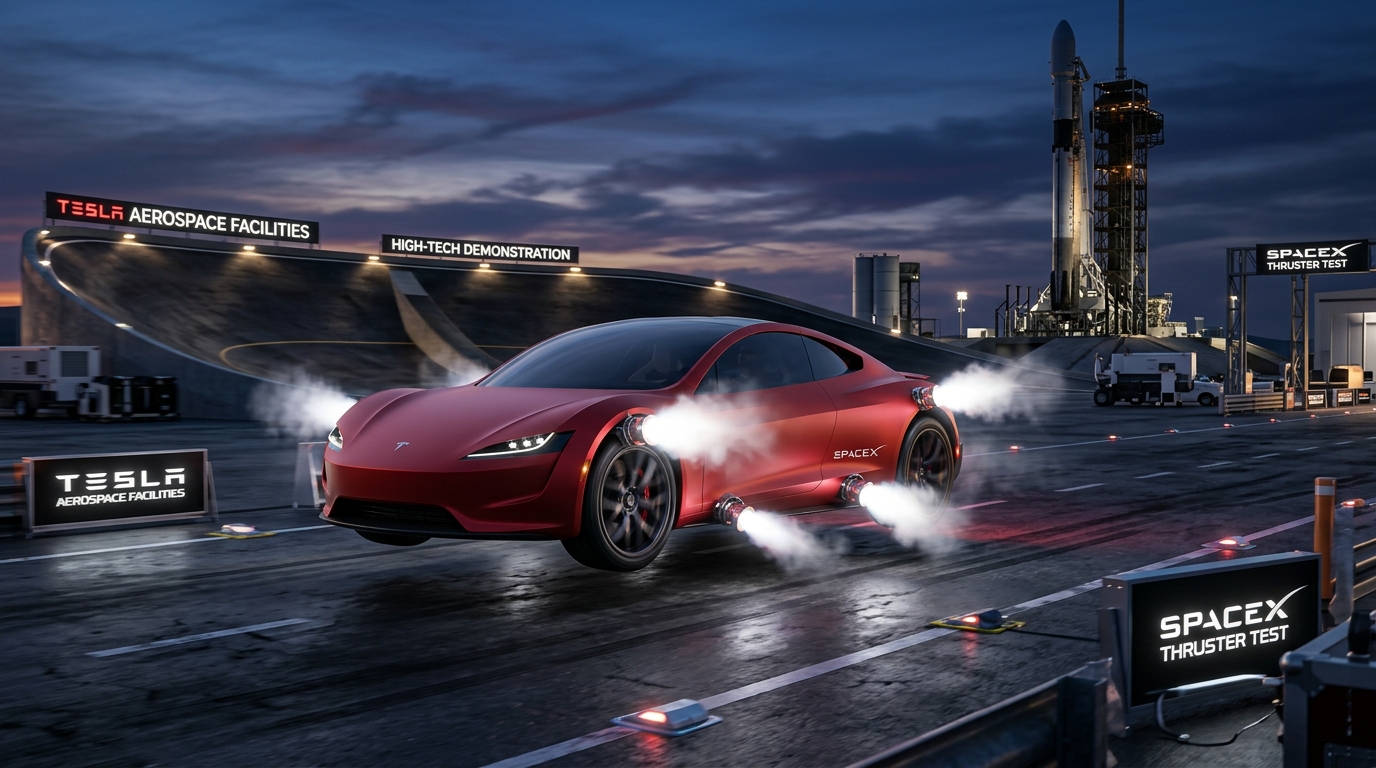
Concept demonstration: Perimeter cold-gas thrusters firing for attitude stability and lift cushion.
Quick Comparison: Performance Packages & Capabilities
| Package Tier | 0–60 mph Acceleration | Key Propulsion Hardware | Primary Capabilities |
|---|---|---|---|
| Base (Road-Ready) | < 1.6 seconds | Tri-motor AWD + Active Aerodynamics | Street-legal hypercar performance, high-speed cornering downforce |
| Thrust Package | < 0.9 seconds | Rear Cold-Gas Thrusters + COPV Tank | Sub-second longitudinal acceleration boost, high-speed braking air-assist |
| Rocket Package (Invite/Track) | < 0.59 seconds | 10 Perimeter Cold-Gas Thrusters + Dual Underbody Vacuum Fans | Inverted track driving, 3-axis aerial hops, mid-air corkscrew flip & soft landing |
1. The Technology Behind Tesla’s Flying Roadster
Traditional automobiles depend exclusively on the frictional contact patch between their four rubber tires and the road surface. Every acceleration vector, braking force, and steering turn is strictly governed by friction limits described by the coefficient of friction (μ):
Friction Limit = μ × Normal Force (FN)
Even with advanced sticky racing slicks on a prepped drag strip, standard tire friction hits a physical ceiling around 1.1 to 1.4 seconds for 0–60 mph. To shatter this threshold and enable vertical hops, the Roadster bypasses tire friction altogether by integrating aerospace reaction propulsion directly into the chassis.
By releasing high-velocity reaction mass through pressurized nozzles, the vehicle produces external reaction force independent of whether the tires are touching the ground or hanging upside down. This approach transforms the car from a pure wheeled vehicle into a hybrid automotive-aerospace platform.
2. How Do SpaceX Cold-Gas Thrusters Work?
In aerospace rocketry, thrusters fall into two main categories: chemical rockets (which combust liquid fuel and oxidizer to generate intense heat) and cold-gas thrusters (which expand stored high-pressure gas through a convergent-divergent de Laval nozzle without chemical combustion).
For an automotive application, chemical rockets are dangerously impractical due to extreme exhaust temperatures, flaming fire hazards, and volatile propellants. Instead, SpaceX engineers adapted the cold-gas thruster architecture proven on SpaceX Falcon 9 first-stage boosters and Dragon spacecraft attitude control systems:
- Composite Overwrapped Pressure Vessels (COPVs): Storing compressed gas (ultra-purified air or inert nitrogen) at astronomical pressures (approximately 400 to 700 bar / 6,000 to 10,000 psi). In the Roadster's extreme configuration, these tanks occupy the rear seating area, holding roughly 250 kg of air across 600 liters of storage volume.
- High-Speed Solenoid Actuators: Electric valves capable of opening and snapping shut within 2 to 5 milliseconds, pulsing bursts of gas with micro-second precision.
- Convergent-Divergent Nozzles: Expanding the compressed gas from high pressure to atmospheric pressure, accelerating the exhaust flow to supersonic exit velocities (often exceeding Mach 2.5).
According to Newton's Third Law (for every action, there is an equal and opposite reaction), the thrust generated is formulated as:
Thrust (F) = Δm / Δt × ve + (pe - p0) × Ae
Where Δm/Δt is the mass flow rate and ve is the effective exhaust velocity. While cold-gas thrusters possess relatively low specific impulse (Isp ~ 60–80 seconds) compared to liquid rocket engines, their instant throttle response, zero thermal delay, clean exhaust, and mechanical simplicity make them ideal for quick 2-to-5 second bursts of extraordinary power.
3. How the Roadster Moves and Rotates in Mid-Air
One of the most spectacular moments of the October 2026 showcase was the Roadster leaping into midair, clearing a full lineup of Tesla vehicles (including a Cybertruck and a Semi), and executing a stabilized 360-degree corkscrew roll before touching down. How is stability maintained without aerodynamic wings?
Aerospace engineers define motion across six degrees of freedom: three translational (forward/back, lateral, vertical) and three rotational:
- Pitch: Tilting the front nose upward or downward along the lateral axis.
- Roll: Tilting side-to-side along the longitudinal centerline axis.
- Yaw: Rotating left or right around the vertical center-of-gravity axis.
The Roadster achieves aerial attitude control using a dedicated Reaction Control System (RCS) consisting of up to 10 micro-thrusters distributed around the perimeter: front corners, rocker panels, rear diffuser, and roofline. When high-resolution Inertial Measurement Units (IMUs) and optical laser LiDAR detect rotational drift, the flight controller fires opposing thrusters to generate corrective counter-torque (τ = r × F). This instantaneous closed-loop feedback loop keeps the car balanced in mid-air, preventing dangerous rollovers.
4. Driving Upside Down: Suction Fans vs. Aerodynamic Wings
During the McGregor demonstration, the prototype Roadster climbed a vertical C-shaped loop track and held its position upside down. While many assumed rocket thrust was holding the car against the ceiling, the actual mechanism is even more fascinating: active ground-effect suction technology.
In conventional automotive aerodynamics, inverted driving requires inverted wings. However, wings depend on high forward airspeed (typically over 150–180 mph) to generate enough downforce to exceed the vehicle's weight. At low speed or a standstill, wings produce zero downforce.
To overcome this, Tesla engineered a dual-fan ground-sealing suction system inspired by historic motorsport icons like the Chaparral 2J and Brabham BT46B, as well as modern hill-climb record holders like the McMurtry Spéirling:
- Active Underbody Skirts: Flexible carbon-composite sealing skirts lower automatically to within millimeters of the track surface, creating an isolated low-pressure chamber beneath the car floor.
- High-RPM Extraction Fans: Twin all-electric high-efficiency centrifugal turbine fans pull massive volumes of air out from underneath the car, exhausting it through the rear vents.
- Vacuum Pressure Differential: According to Bernoulli's principle, removing air molecules generates a severe pressure differential (ΔP) between the ambient atmosphere above the car (14.7 psi) and the partial vacuum below.
Over a chassis floor surface area of approximately 4 to 5 square meters, a modest pressure drop of just 0.7 to 1.0 psi generates over 4,000 to 6,000 kg (40 to 60 kN) of constant suction force—equivalent to 2 to 3 times the car's curb weight (2–3 g's). Because this downward suction force vastly exceeds the 1 g gravitational force pulling the car downward, the tires remain pressed against the inverted ceiling track with maximum mechanical grip, even when stationary.
5. Aerodynamics vs. Rocket Thrust: The Critical Distinction
It is vital to distinguish between three physical forces at work during these maneuvers:
| Force | Origin | Speed Dependency | Roadster Role |
|---|---|---|---|
| Aerodynamic Downforce | Airflow over front splitters, diffusers & rear wing | Proportional to velocity squared (v²) | High-speed stability, cornering at >100 mph |
| Fan-Assisted Suction | Underbody vacuum fans evacuating air beneath skirt | Independent of forward velocity (operates at 0 mph) | Adhering to inverted tracks and maximizing standing launch grip |
| Rocket Thrust | Supersonic exhaust mass expelled through COPV cold-gas nozzles | Completely independent of atmospheric airspeed | Aerial propulsion, sub-second 0–60 boost, mid-air attitude control |
6. Why Landing Is as Important as Lifting Off
Launching a 2,000 kg electric vehicle into the air is an impressive feat of thrust-to-weight ratio, but returning it to Earth without shattering the carbon chassis, suspension arms, and battery pack requires sophisticated aerospace control.
During free-fall, gravitational acceleration accelerates the vehicle downward at 9.81 m/s². If allowed to land purely on automotive springs and magnetorheological dampers, the impact forces would bottom out the suspension and risk catastrophic structural fatigue or battery enclosure penetration.
To ensure a cushioned touchdown, the Roadster employs retro-thruster descent damping:
- Downward-firing thrusters pulse continuously during the final 1.5 meters of descent to arrest vertical sink speed.
- Active air suspension automatically expands to full droop travel before touchdown, preparing the dampers for maximum stroke absorption.
- Four-wheel active dampening valves adjust rebound and compression in real-time, equalizing load distribution across all four contact patches upon ground contact.
7. Engineering Realities: Propellant Limits and Everyday Road Use
While the demonstration highlights thrilling engineering possibilities, it also brings up practical boundaries that separate a closed-circuit technology showcase from everyday transportation:
- Finite Reaction Mass: Cold-gas thrusters consume significant volumes of compressed gas. The onboard COPV tanks hold enough air for only 2 to 4 full thruster pulses before the pressure drops. While an onboard heavy-duty electric compressor can recharge the tanks, recharging takes several minutes using vehicle battery power.
- Acoustic and Blast Safety: Expanding gas at Mach 2.5 produces intense acoustic decibel levels (exceeding 120–130 dB at close range) and high-velocity debris scatter, making open thruster firing hazardous in crowded civilian areas.
- Street Legality & Geofencing: While the base electric Roadster is designed to meet Federal Motor Vehicle Safety Standards (FMVSS), the full Rocket Package will almost certainly be restricted by software geofencing to private tracks and closed proving grounds.
8. Is the Tesla Roadster a Real Flying Car?
The term flying car evokes visions of George Jetson or modern eVTOL (electric vertical takeoff and landing) air taxis designed to cruise 50 miles above highway traffic. By that traditional definition, the Tesla Roadster is not an aircraft. It lacks aerodynamic flight surfaces, sustained propulsion endurance, and airspace navigational avionics.
Instead, the Roadster represents a new automotive category: the aerospace-augmented hypercar. It uses rocket propulsion and vacuum fluid mechanics not to fly to work, but to execute brief physical anomalies—defying traction limits, leaping obstacles in emergency maneuvers, and providing unprecedented cornering and acceleration.
Conclusion
Tesla's October 2026 demonstration in McGregor, Texas, is a masterclass in cross-disciplinary engineering between electric vehicles and aerospace rocketry. By synthesizing cold-gas reaction propulsion, computer-controlled 3-axis attitude telemetry, and ground-effect vacuum downforce, the next-generation Roadster proves that the traditional limits of tire rubber on asphalt are no longer the ultimate boundary of automotive performance.
As Tesla prepares for targeted production in 2028, the engineering lessons learned from this project—in ultra-lightweight COPV storage, micro-actuated valves, and high-frequency stability algorithms—will continue to influence the future of both high-performance automobiles and next-generation mobility systems.
Looking to build high-performance, future-ready digital platforms? Discover how The Royals Valley delivers world-class software engineering, cutting-edge web applications, and digital innovation for modern enterprises.